
Layer by Layer: The Fascinating History and Evolution of 3D Printing
We live in a world of instant gratification. If you need a small bracket for a shelf, a custom cookie cutter, or a replacement knob for your kitchen appliance, you don't necessarily have to run to the hardware store anymore. With a digital file and a desktop 3D printer, you can literally print it into existence in your own home.
But have you ever wondered how this technology came to be? While it feels like a modern sci-fi miracle, 3D printing has been quietly evolving for over four decades. Let’s take a journey back to see how a few visionary engineers turned science fiction into reality, layer by layer.
The Birth of an Idea: When Did It All Begin?
While popular culture often associates 3D printing with the 2000s, the roots of the technology stretch all the way back to the early 1980s.
The concept didn't start with plastic spools and glowing nozzles; it started with liquid photopolymers—plastics that cure and harden when exposed to light.
1981: Dr. Hideo Kodama of the Nagoya Municipal Industrial Research Institute published the first-ever account of a functional rapid prototyping system using UV light to cure photopolymer resin. Unfortunately, due to a lack of institutional funding and patent filing issues, he couldn't take the invention commercial.
1984: A trio of French inventors (Alain Le Méhauté, Olivier de Witte, and Jean Claude André) filed a patent for the stereolithography process. Sadly, their corporate employers abandoned the project, citing a lack of commercial potential.
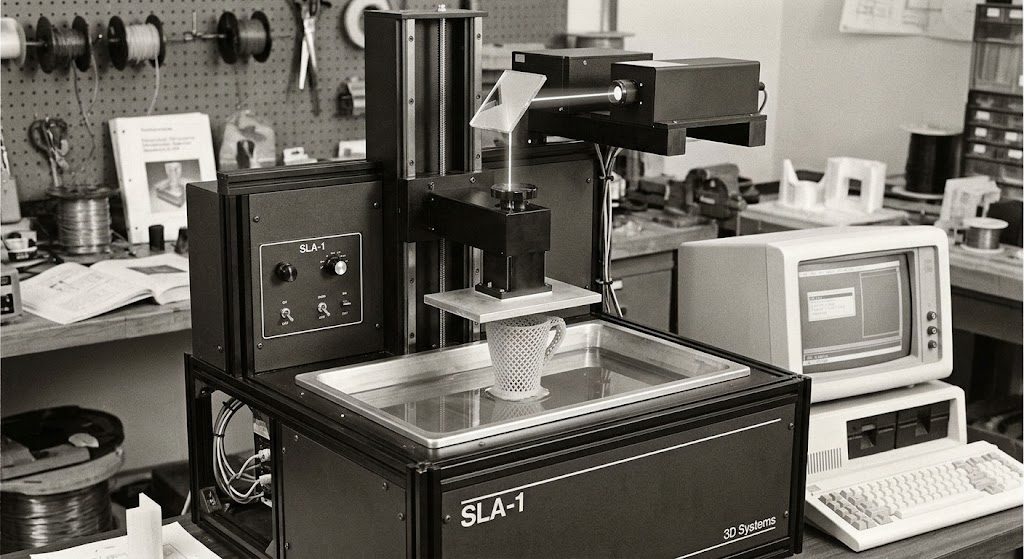
The Breakthrough: Chuck Hull and Stereolithography (1986) The true commercial dawn of 3D printing arrived in 1986, when American engineer Chuck Hull successfully patented the first-ever stereolithography apparatus (SLA) machine.
Frustrated by how long it took to manufacture small plastic parts for tool prototyping, Hull invented a process where a UV laser beam was traced across a vat of liquid photopolymer, solidifying it layer by microscopic layer.
To commercialize his invention, Hull co-founded 3D Systems in 1986 and released the world's first commercial 3D printer, the SLA-1, in 1987. What used to take weeks or months of traditional tooling could now be prototyped in a matter of days.
Expanding the Toolbox: FDM and SLS Emerge As the 1980s turned into the 1990s, innovators began exploring alternative ways to build objects layer by layer:
Fused Deposition Modeling (FDM) – 1989: Invented by S. Scott Crump (co-founder of Stratasys), FDM is the technology most people picture today. Instead of using liquid resin, it melts a continuous filament of thermoplastic (like PLA or ABS) and extrudes it through a moving print head. Crump came up with the idea while trying to build a toy frog for his daughter using a glue gun loaded with a mixture of polyethylene and candle wax.
Selective Laser Sintering (SLS) – 1989: Developed by Dr. Carl Deckard at the University of Texas, SLS used a high-powered laser to fuse small particles of plastic, metal, or ceramic powders together. This allowed for incredibly complex geometries that didn't require support structures.
The Open-Source Revolution: Bringing It to the Masses For its first two decades, 3D printing was strictly an industrial enterprise. Machines cost tens or hundreds of thousands of dollars, and materials were proprietary and expensive.
That all changed in 2005 with the launch of the RepRap Project by Adrian Bowyer at the University of Bath. The goal was radical: create an open-source 3D printer that could print most of its own plastic components.
The success of the RepRap movement triggered an explosion of hobbyist printer manufacturers (like MakerBot and Prusa Research) in the late 2000s and early 2010s. When key industrial patents for FDM technology began expiring around 2009, the market flooded with affordable, user-friendly desktop machines.
Where We Are Today What began as a clumsy method for making rough industrial prototypes has matured into a cornerstone of modern manufacturing:
Medical Breakthroughs: Surgeons use 3D printing to create patient-specific surgical guides and biocompatible prosthetics.
Aerospace & Automotive: Companies print lightweight, high-strength titanium and carbon-fiber composite parts for rockets and race cars.
Art, Craft, and Small Business: Makers and independent designers use desktop printers to launch micro-businesses, creating everything from custom home organization tools and eco-friendly plant pots to intricate tabletop gaming miniatures.
Whether you're downloading a free file to print a quick household fix or commissioning a complex custom piece from a local maker, you are participating in a manufacturing revolution that has been decades in the making.